How a furniture workshop runs on BARITA.
Promised dates are worked out from stock and booked work, and every order shows whether it makes money.
The setting: 14 craftsmen making wooden furniture to order.
It started with one simple request.
“We make wooden furniture to order in our workshop with 14 craftsmen. Orders come in from shops and private customers, and we track them on a big whiteboard and in a notebook, so we often promise delivery dates we can't keep. …”
Read the whole request
We make wooden furniture to order in our workshop with 14 craftsmen. Orders come in from shops and private customers, and we track them on a big whiteboard and in a notebook, so we often promise delivery dates we can't keep. We run out of timber or hardware halfway through a job, and nobody knows exactly where each order is in cutting, assembly, finishing or upholstery. I want to manage customer orders and quotes, the materials each job needs and our stock, the production stages of each job and who is working on it, and delivery dates, and see what we have in production and whether we're making money on each order.
What gets in the way.
Orders were tracked on a whiteboard and in a notebook, and delivery dates were promised that could not be kept.
Timber or hardware ran out halfway through a job.
Nobody knew where each order was in cutting, assembly, finishing or upholstery.
There was no view of what is in production now.
It was not clear whether each order made money.
Watch the crew take it on.
We make wooden furniture to order in our workshop with 14 craftsmen. Orders come in from shops and private customers, and we track them on a big whiteboard and in a notebook, so we often promise delivery dates we can't keep. We run out of timber or hardware halfway through a job, and nobody knows exactly where each order is in cutting, assembly, finishing or upholstery. I want to manage customer orders and quotes, the materials each job needs and our stock, the production stages of each job and who is working on it, and delivery dates, and see what we have in production and whether we're making money on each order.
The request as it was typed.
The requestKeep the delivery dates we promise
The work appears here
How each one is removed.
Orders were tracked on a whiteboard and in a notebook, and delivery dates were promised that could not be kept.
The suggested date is worked out from stock, purchases on order and the hours already booked in each stage, and the office makes the promise.
The app the crew designed
Timber or hardware ran out halfway through a job.
Each job's materials are checked against stock and purchases on order, so a shortage shows before the job starts, with what to reorder.
A routine that runs by itself
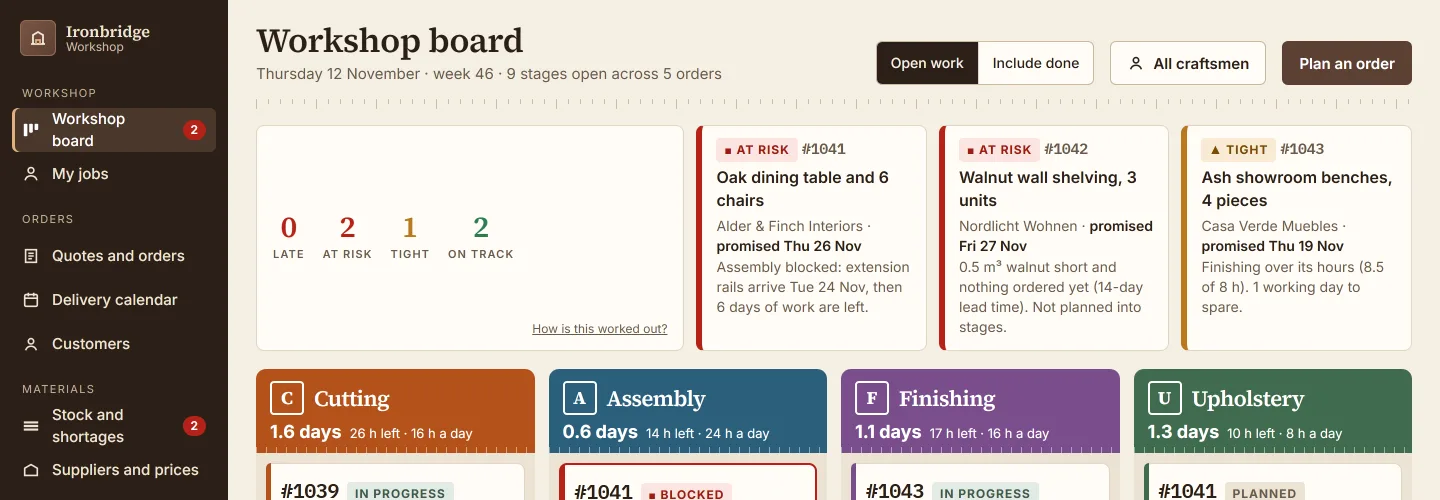
Nobody knew where each order was in cutting, assembly, finishing or upholstery.
The workshop board shows a lane per stage with the days of work queued, the jobs blocked and the craftsman on each.
The app the crew designed
There was no view of what is in production now.
Orders at risk, work left and materials short are shown together, week by week.
A dashboard for the owner
It was not clear whether each order made money.
Ask which orders earn their keep, and the crew answers from prices, materials and recorded hours.
A plain question, answered
What this takes off your plate.
Dates you can keep
The office sees at risk before promising, instead of finding out on delivery day.
No surprises at the saw
Shortages show before a job starts, with what to reorder.
The whiteboard retires
Every order shows its stage, who is on it and whether it still makes money.
Read next
Building contractor
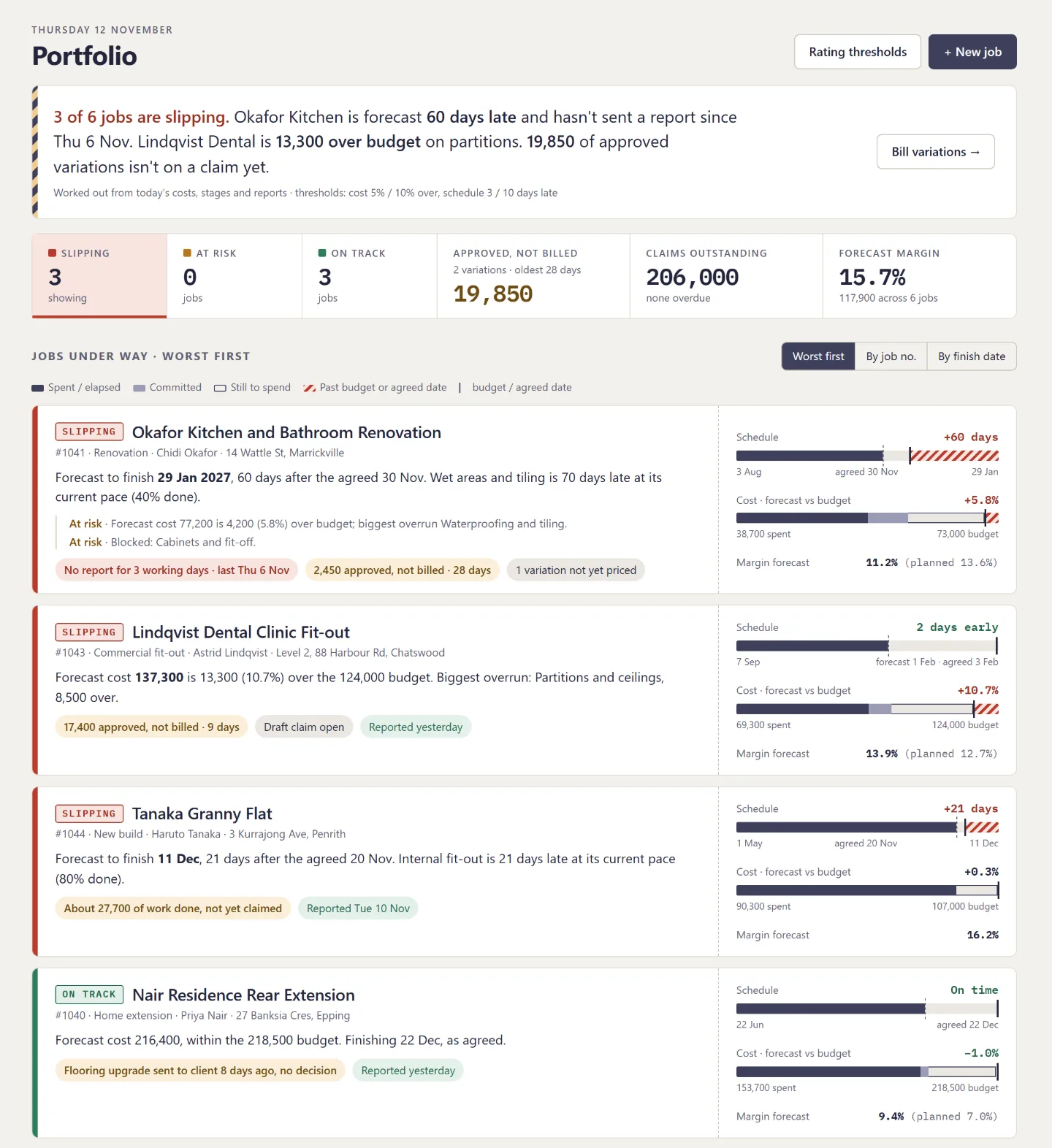
Slipping jobs show early, and changes agreed on site end up on a claim.
Costs, schedules and client changes lived in spreadsheets and in people's heads. The crew designed one app for the owner, the office and the site managers.
Your turn. One message is enough to start.
Say what your business needs in your own words. The crew plans it, shows you the screens, and builds once you agree.